Independent UX / HCI Investigation
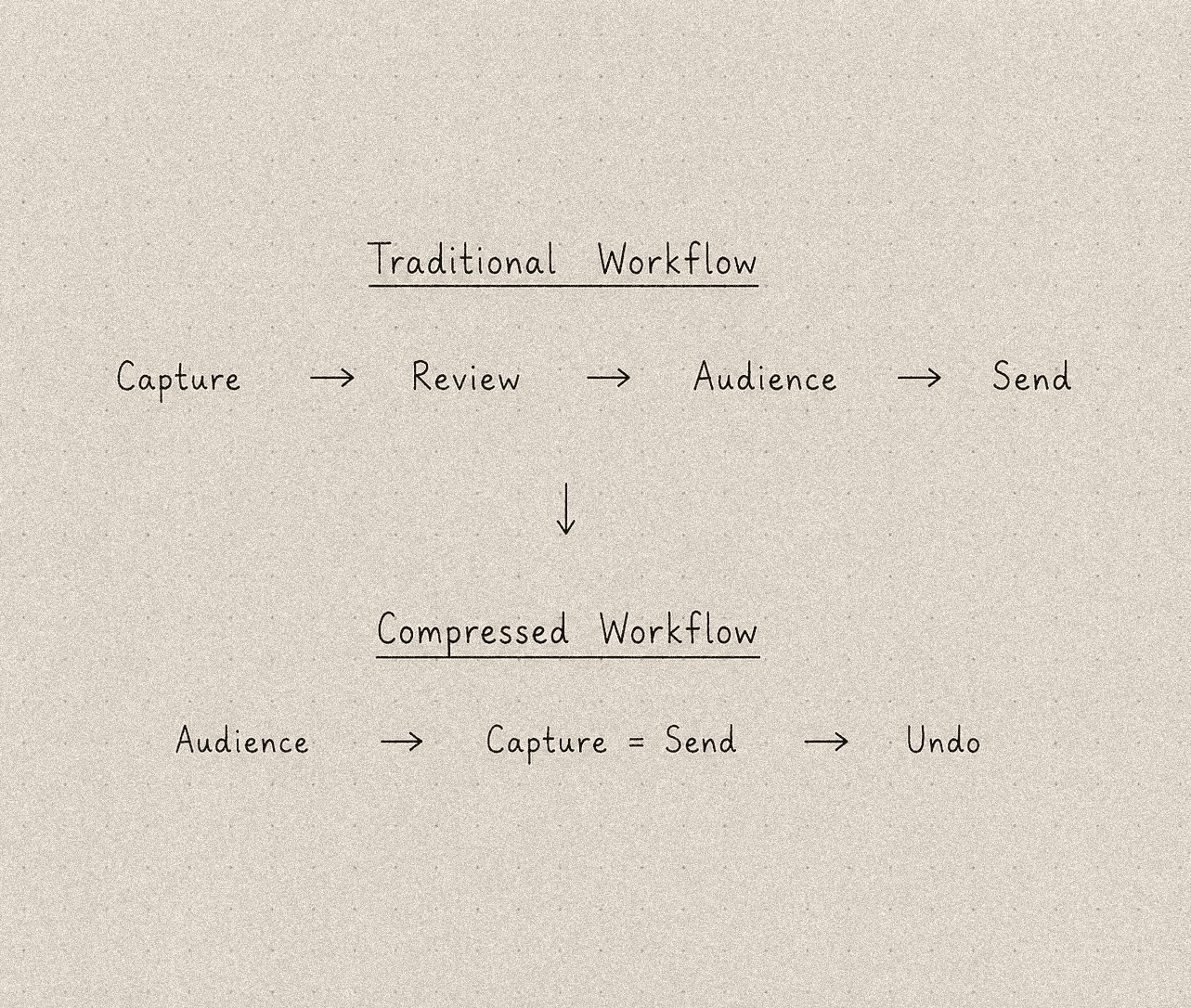
Actions that once required confirmation, review, or deliberate intent are being compressed into single-step interactions.
Using Meta’s Instants experience as a live interaction specimen, this investigation examines how removing confirmation reshapes user behavior, redistributes cognitive responsibility, and alters established interaction expectations.
The study explores the tradeoffs between interaction velocity, error prevention, and psychological safety - culminating in a generalized framework for evaluating friction in high-consequence mobile systems.
Reseach question
Friction is often framed as a usability defect.
Reduce taps.
Shorten flows.
Accelerate completion.
Modern digital systems increasingly equate speed with better user experience.
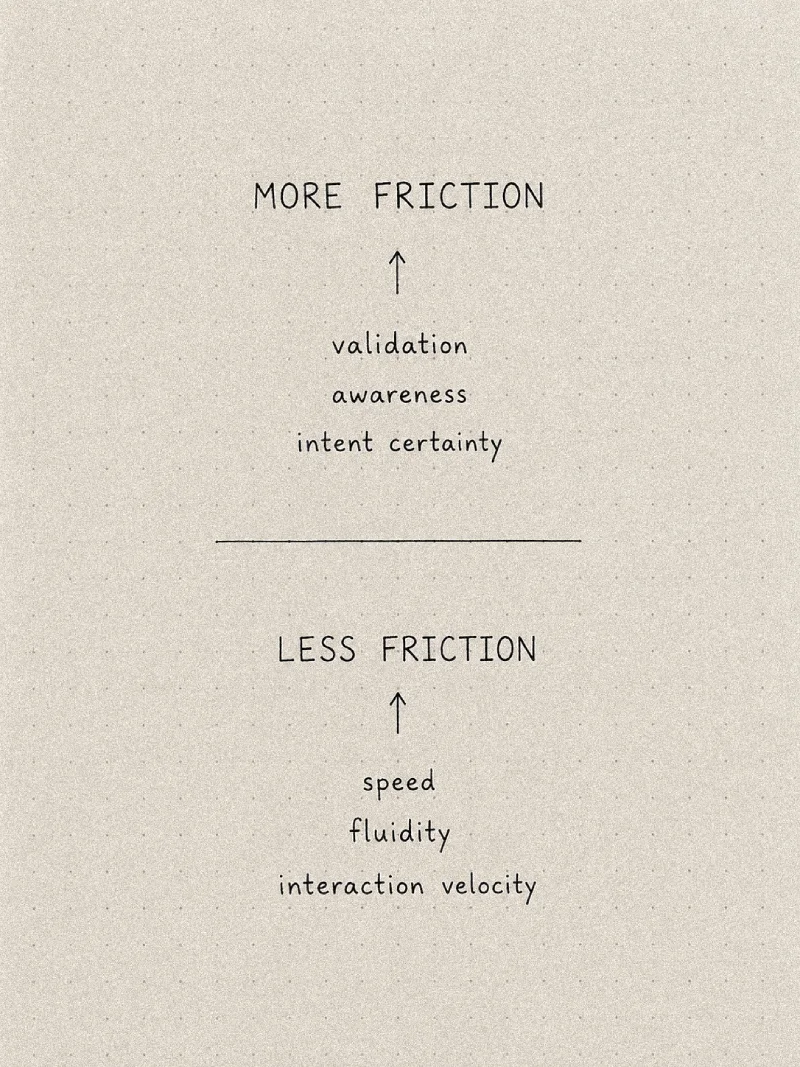
But not all friction is waste.
In many interaction contexts, friction performs invisible cognitive work —
helping users validate intent, recognize consequence & recover from uncertainty before action becomes commitment.

Intent Validation
Friction creates a pause between impulse and commitment.
Confirmation steps, gestures & staged workflows help systems distinguish accidental actions from deliberate intent.
Trust Infrastructure
Predictable interaction rituals build long-term behavioral trust.
Users learn what systems expect & what systems will protect them from.
Error Prevention
Strategic checkpoints reduce execution mistakes, action slips & context confusion before the system performs a consequential action.
Consequence Awareness
Additional interaction layers can surface what is at stake before execution.
“Where is this going?”
“Who sees this?”
“Can this be reversed?”
Action Slips
When execution outruns intention
Users often operate through learned motor behavior rather than deliberate conscious reasoning.
In familiar interfaces, actions become habitual.
When a system suddenly changes the meaning of an established interaction, users may execute the old behavior inside a new architecture.
The result is not misunderstanding.
It is behavioral mismatch.
Friction as Invisible Infrastructure
Interaction Tradeoff Model
Mental Models
Learned expectations shape interface interpretation
Users interact through accumulated assumptions.
Over years of repeated exposure, workflows become internalized:
capture.
review.
confirm.
send.
Systems that alter these conventions inherit the burden of re-teaching expectation.
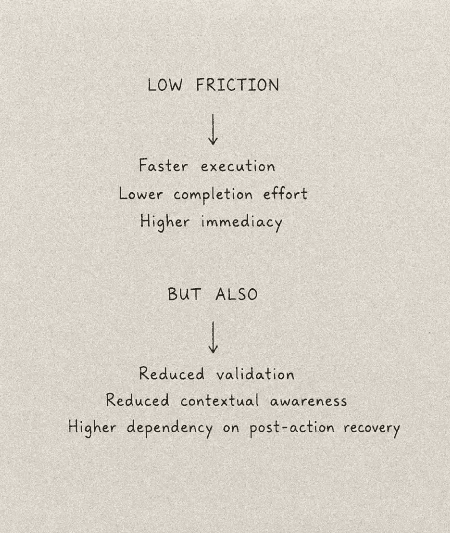
Removing friction does not remove cognitive work — it redistributes where that work occurs.
How confirmation moved from pre-action validation to post-action recovery
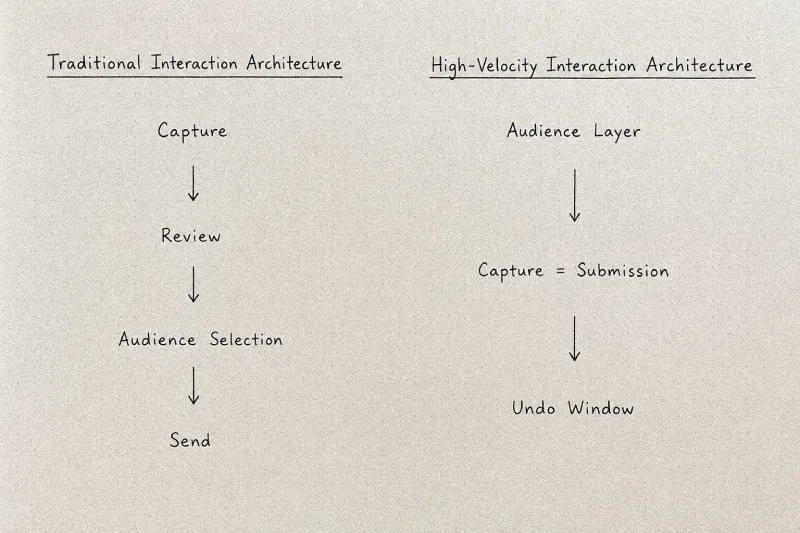
Many messaging and camera workflows historically separate capture, review & submission into distinct interaction checkpoints.
Meta’s Instants interface compresses these checkpoints into a higher-velocity interaction model.
Meta’s Instants interface compresses these checkpoints into a higher-velocity interaction model.
(High Control / Low Anxiety)
Capture
Create content.
↓
Review
Validate quality, context, intent.
↓
Audience Selection
Define destination.
↓
Send
Commit action.
(Low Control / High Anxiety)
Audience Layer
Context pre-selected
↓
Capture = Submission
Single interaction → creation + delivery.
↓
Undo-Window
Time-limited recovery
Traditional systems distribute cognitive responsibility across multiple checkpoints.
Instants consolidates validation, execution, and consequence into a narrower interaction window.
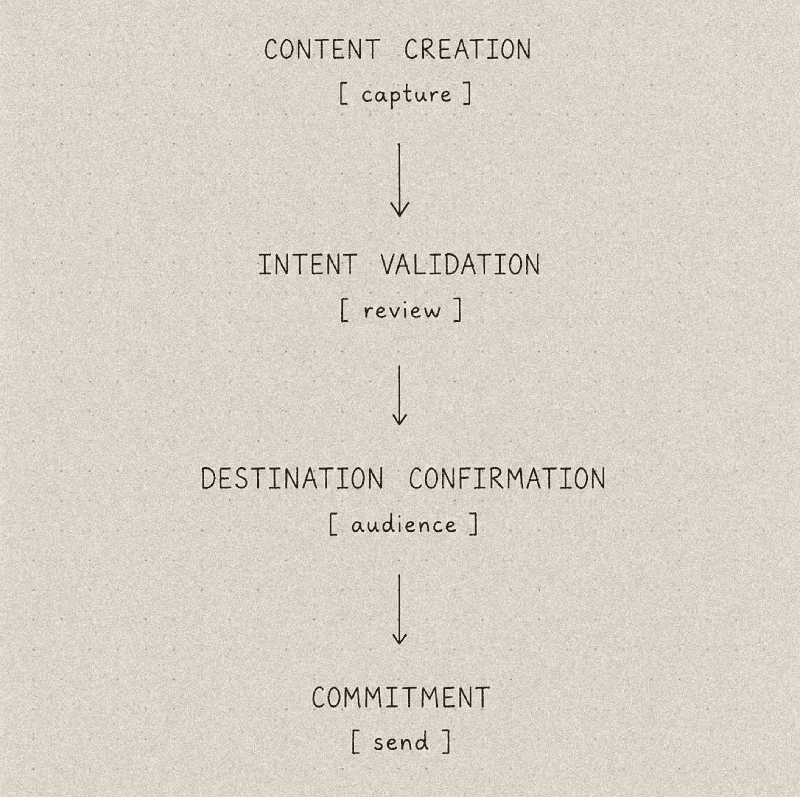
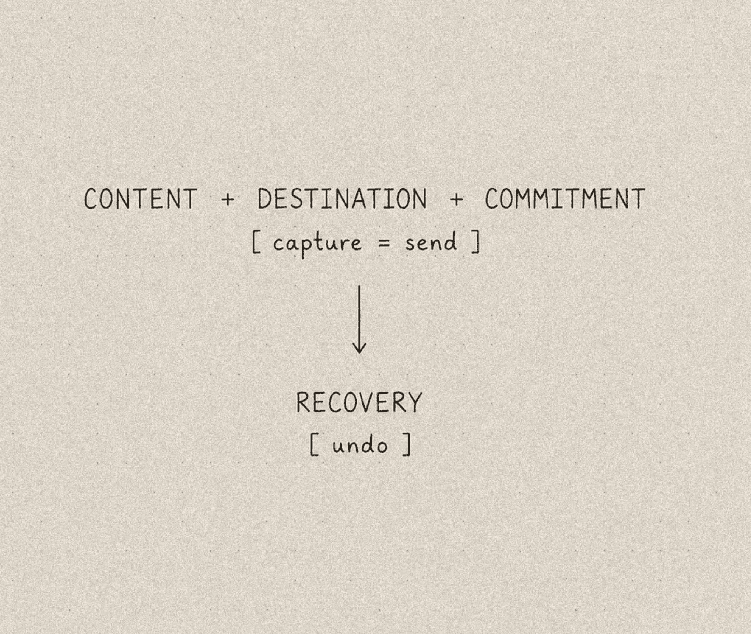
Multiple cognitive checkpoints collapse into a single interaction moment.
I developed the Friction-Safety Matrix as a decision-making model to evaluate interaction thresholds based on two universal metrics: Reversibility and Consequence Impact.

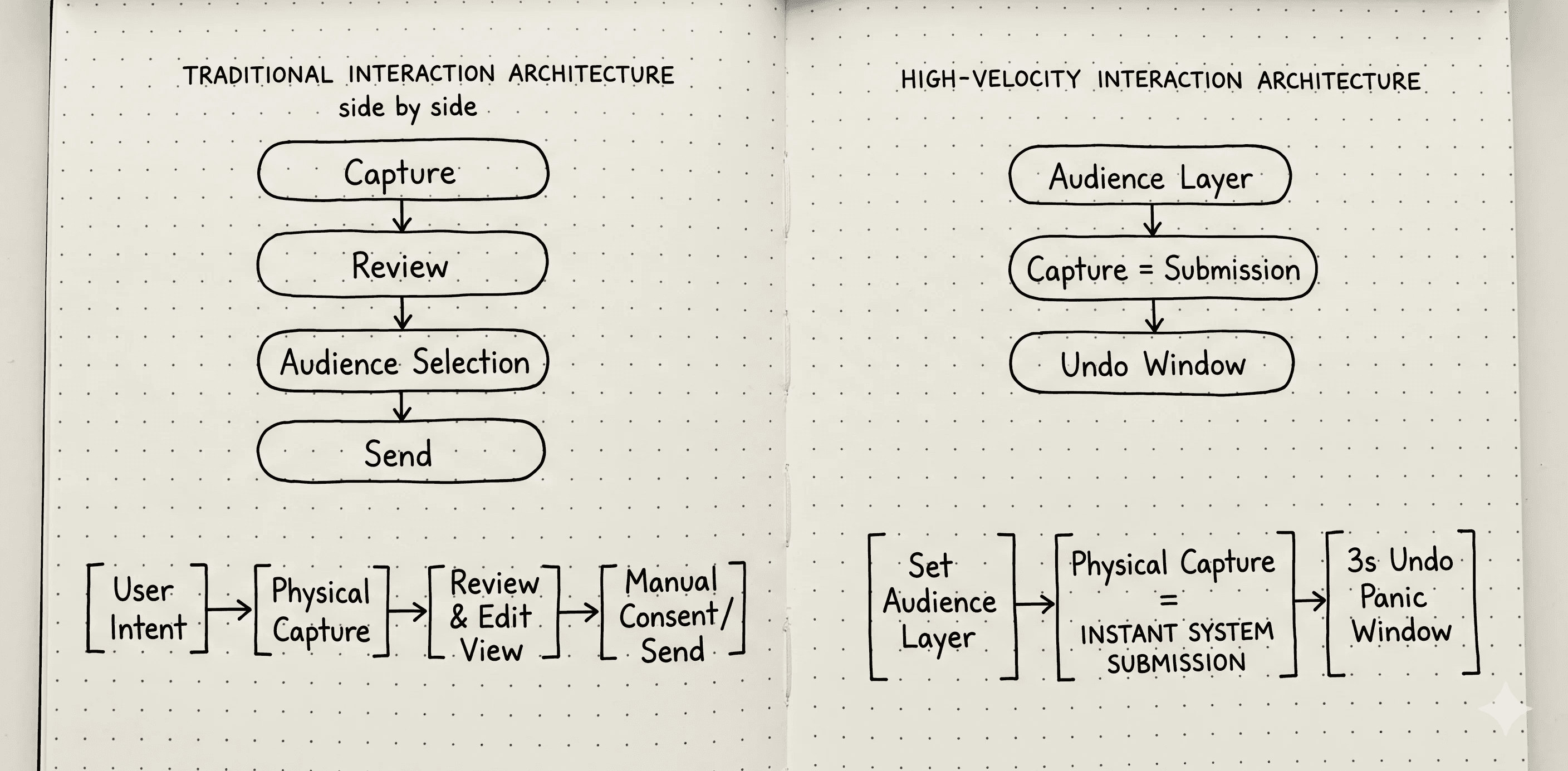
Multiple cognitive checkpoints collapse into a single interaction moment.
Tradeoff Analysis
Reduced Completion Cost
Fewer steps.
Lower interaction latency.
Higher immediacy.
Increased Behavioral Spontaneity
Shorter flows encourage in-the-moment sharing behavior.
Simplified Interaction Surface
Minimal interface complexity.
Reduced decision overhead during execution.
Reduced Validation Space
Less opportunity to reassess intent.
Higher Dependency on Recovery
Error handling shifts toward undo mechanisms.
Convention Override
Previously learned interaction expectations may no longer align with execution outcomes.
This architectural shift raises a broader behavioral question:
Understanding that tension requires examining how humans operate inside familiar systems.
Users rarely interact with interfaces through deliberate step-by-step reasoning.
Repeated exposure transforms workflows into behavioral routines.
Capture.
Review.
Choose audience.
Send.
Over time, these sequences become learned expectations rather than consciously evaluated decisions.
When interaction architectures change, systems inherit the challenge of renegotiating those expectations.
Investigation #1
Action Slips
When execution follows an outdated interaction model
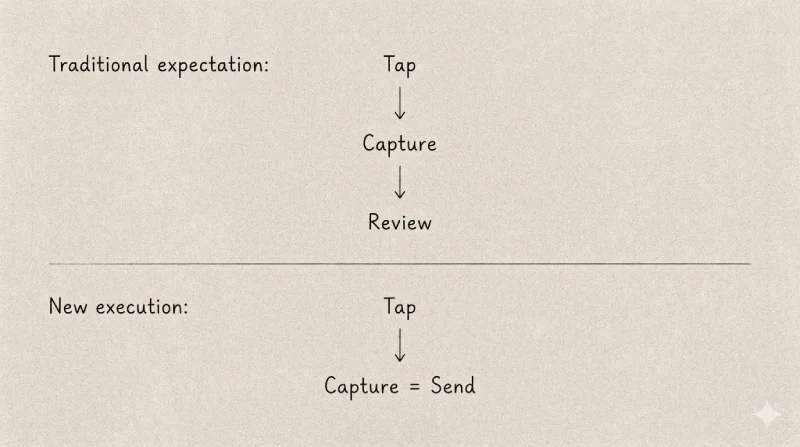
Users may execute a familiar physical behavior while operating inside a newly altered workflow.
In conventional camera systems, tapping the shutter initiates creation.
In Instants, the same gesture performs creation & commitment simultaneously.
The behavioral mismatch does not emerge from misunderstanding.
It emerges from a previously reliable motor expectation colliding with a redefined system rule.
Investigation #2
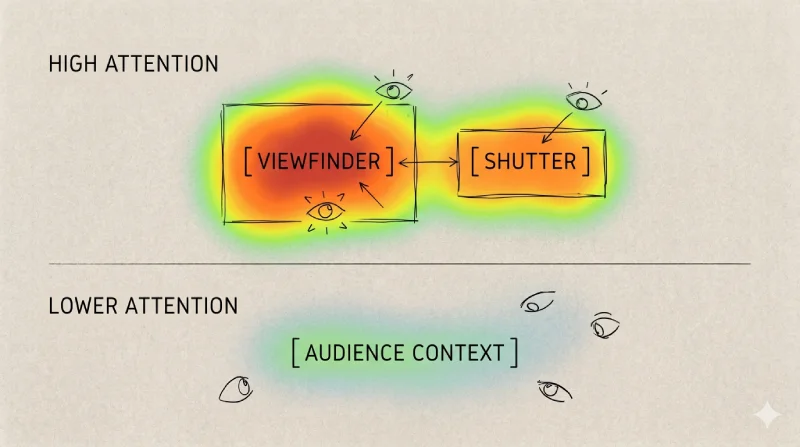
Attentional Blindspots
When context exists but visibility weakens recognition
The interface introduces destination context through an audience layer.
However, context presence does not guarantee context salience.
In fast mobile interactions, visual attention tends to concentrate around:
viewfinder content
primary action targets
motion feedback
Passive contextual indicators risk becoming informational background rather than active decision signals.
Investigation #3
Monitoring Burden
When recovery replaces validation
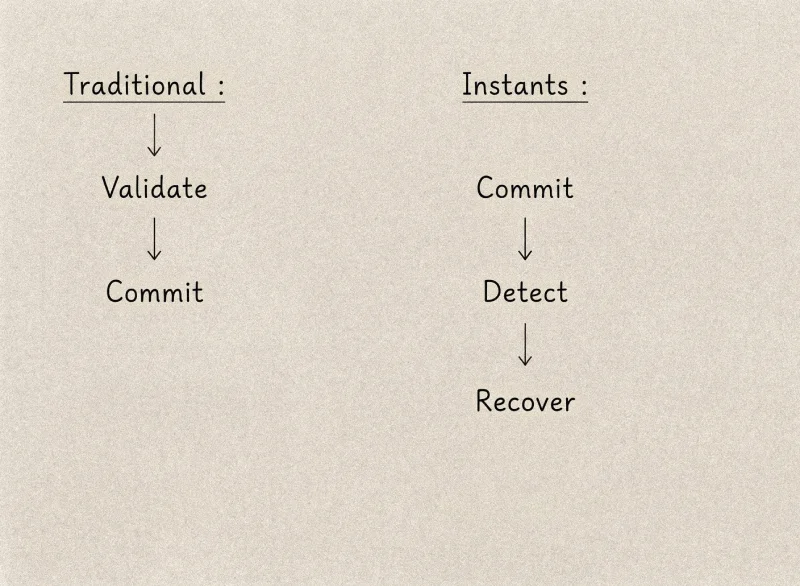
Traditional systems distribute verification before commitment.
Instants repositions part of this workload after execution.
The interaction no longer asks:
“Are you ready to send?”
Instead, it asks:
“Did you mean to send?”
This shift changes the user’s role from validator to monitor.
Recovery becomes dependent on rapid detection, interpretation & corrective action inside a limited temporal window.
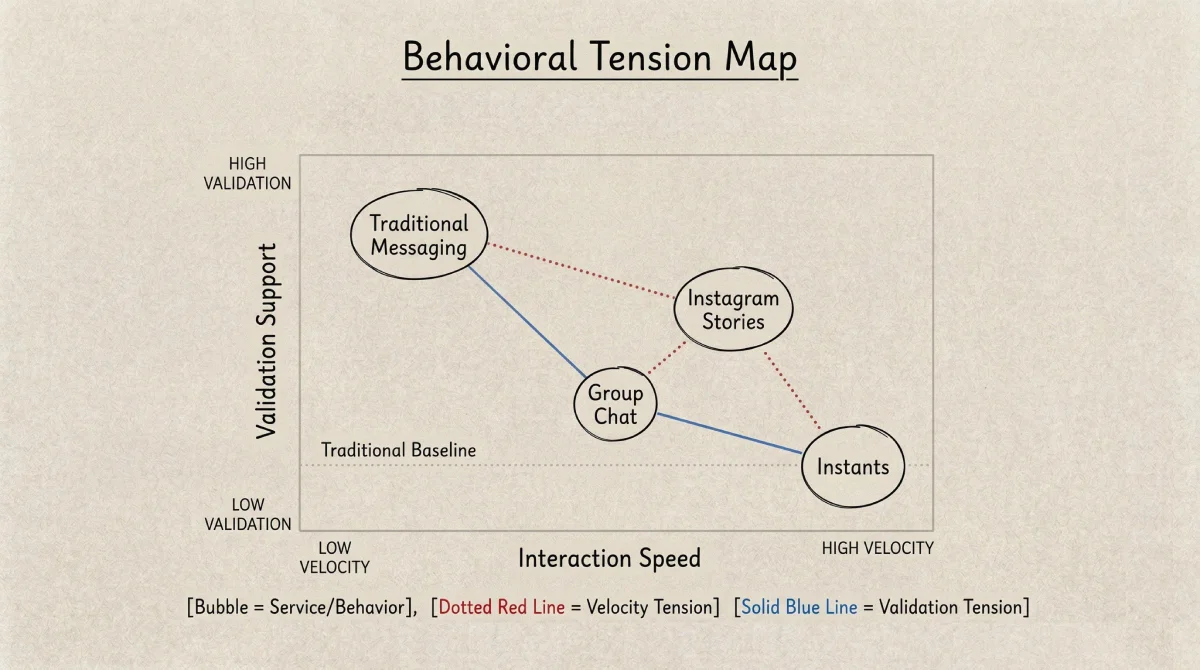
Higher interaction velocity can reduce decision latency while simultaneously narrowing validation space.
Understanding these behavioral tensions raises a design question:
The next section explores a set of design interventions addressing that question.
Removing friction is not inherently problematic.
The challenge emerges when interaction speed outpaces visibility, validation, or consequence awareness.
Rather than reintroducing heavy confirmation flows, this investigation explores whether lightweight behavioral guardrails can preserve velocity while improving interaction support.
Design Hypothesis
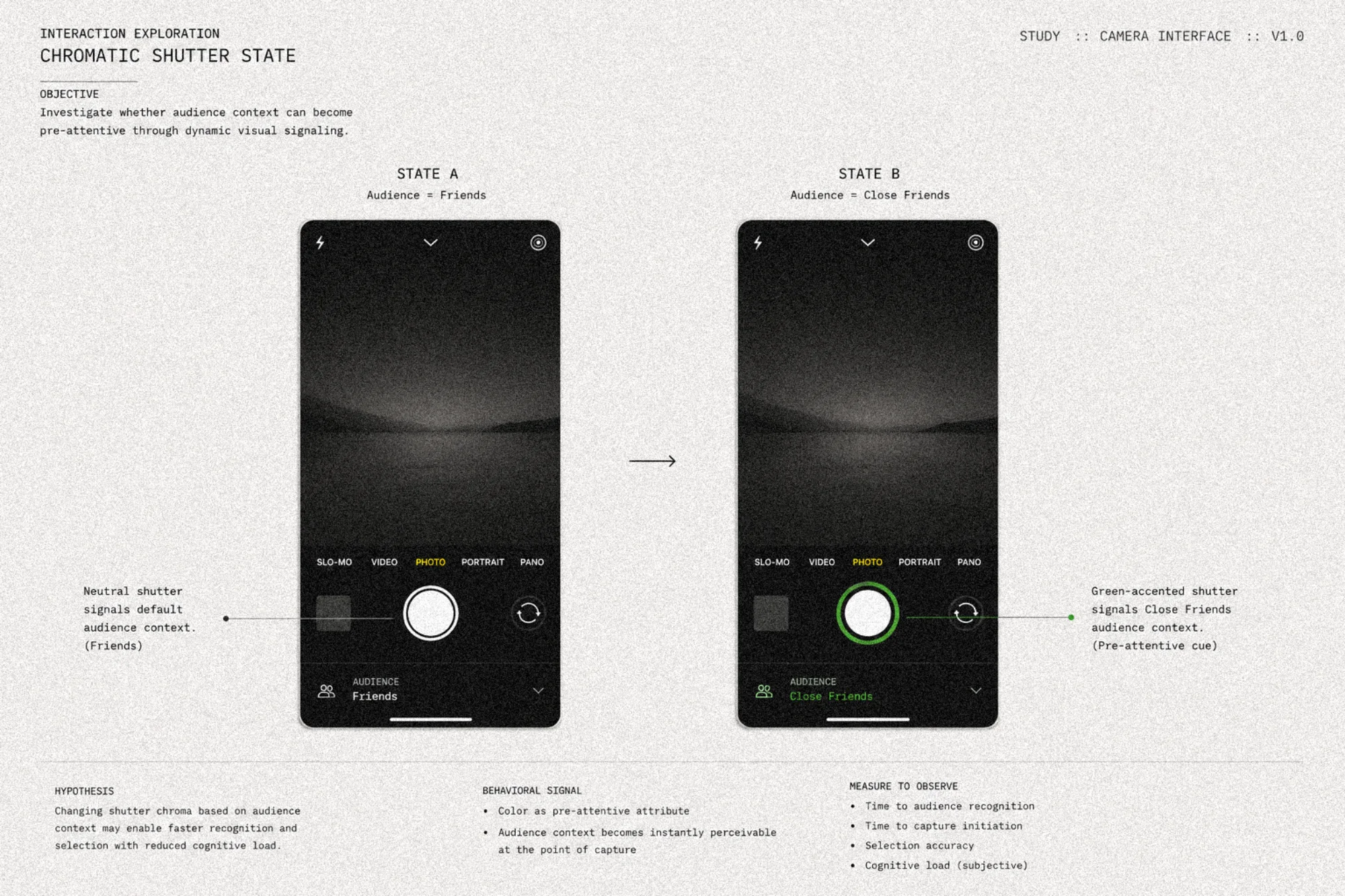
High-velocity systems may reduce behavioral failure modes when validation cues become:
pre-attentive
contextually visible
and
embedded directly inside the primary interaction zone.
Intervention #1
The Chromatic Shutter State
Addressing attentional blindspots
Problem:
Audience context lacks salience during rapid interaction.
Proposal:
Examples:
Close Friends → green state
Wider audience → alternate state
Why?
Intervention #2
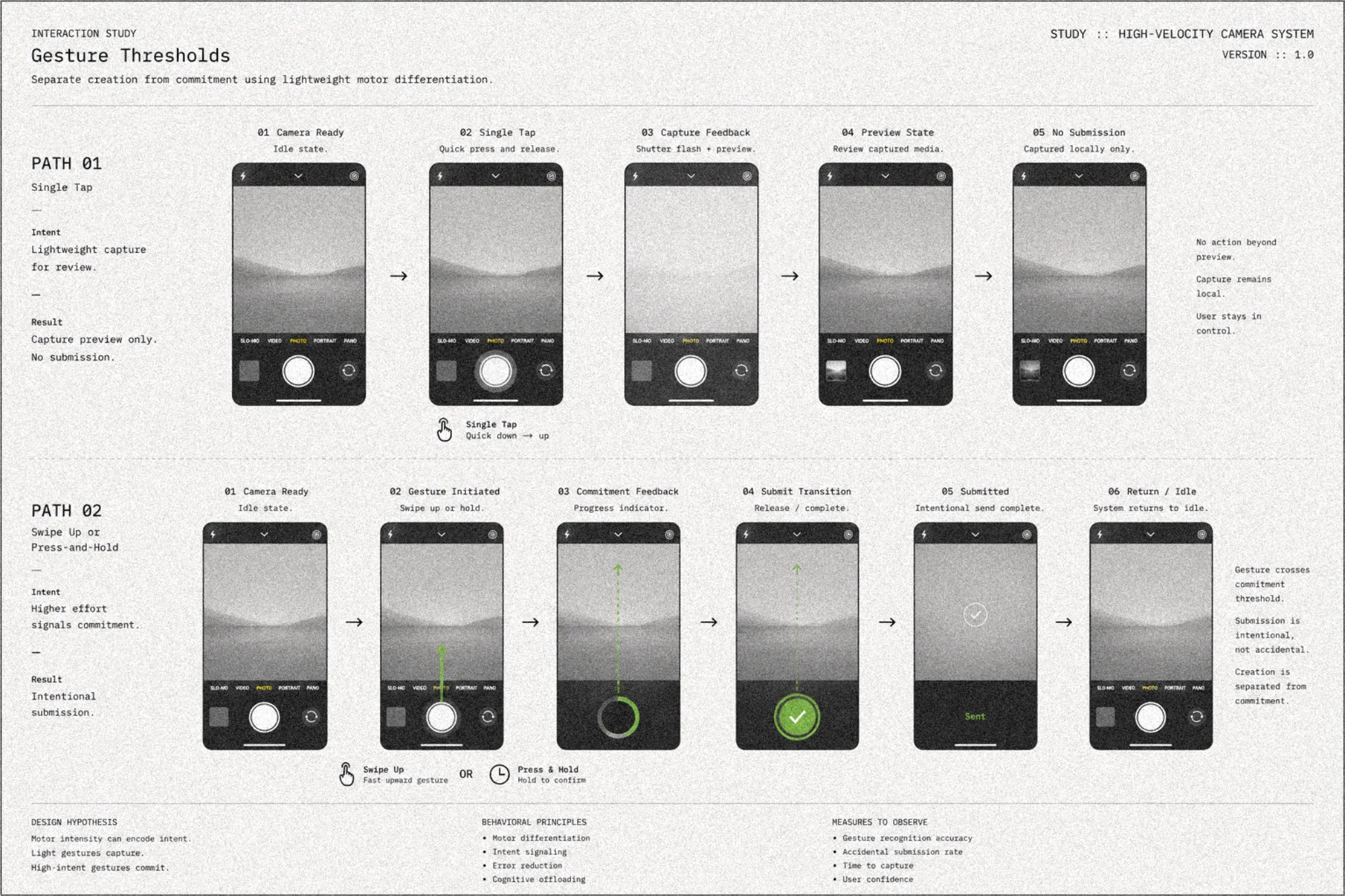
Gesture Thresholds
Addressing action slips
Problem:
Proposal:
Example exploration:
Tap → capture preview
Swipe / hold → submission
Why?
The goal is not increased friction.
The goal is intentional differentiation between creation and commitment.
Intervention #2
Embedded Recovery Feedback
Addressing monitoring burden
Problem:
Proposal:
Example exploration:
Countdown ring surrounding shutter.
Undo anchored inside thumb zone.
Why?
Detection effort decreases.
Proposed Intervention

High-velocity systems may reduce behavioral failure modes when validation cues become:
pre-attentive
contextually visible
and
embedded directly inside the primary interaction zone.
Design Outcome Hypothesis
Expected Behavioral Effects
Chromatic signaling → improved context recognition.
Gesture thresholds → reduced action slips.
Embedded recovery → lower monitoring burden.
Evaluation Matrix
Transition
These interventions are not intended as definitive answers.
They represent a broader design inquiry into how systems might redistribute friction without sacrificing immediacy.
To generalize these findings beyond Instagram, the final section develops a reusable interaction evaluation framework.
The tension between speed and validation is not unique to social interfaces.
As digital systems increasingly automate, compress, and accelerate workflows, designers require clearer criteria for determining when friction should be minimized, redistributed, or deliberately preserved.
This investigation culminated in a reusable evaluation model for assessing interaction thresholds.
QUADRANT #2
High Reversibility / High Consequence
Recommended Pattern:
Accelerated Execution + Immediate Recovery
Design priority:
speed
plus
high-visibility undo mechanisms
QUADRANT #2
High Reversibility / Low Consequence
Recommended Pattern:
Zero-Friction Execution
Design priority:
velocity
fluidity
minimal interruption
QUADRANT #3
Low Reversibility / Low Consequence
Recommended Pattern:
Intentional Thresholding
Design priority:
gesture separation
confirmation affordances
minor validation checkpoints
QUADRANT #4
Low Reversibility / High Consequence
Recommended Pattern:
Strong Validation Architecture
Design priority:
explicit consent
multi-step validation
high clarity erruption
Framework Application
Instants appears to operate near the boundary between:
High Reversibility / High Consequence
and
Lower Validation / High Velocity
The behavioral tensions observed throughout this investigation may stem less from reduced friction itself — and more from how validation, context visibility & recovery support are distributed within the interaction model.
I developed the Friction-Safety Matrix as a decision-making model to evaluate interaction thresholds based on two universal metrics: Reversibility and Consequence Impact.
Key Takeaway for Future Interfaces
The fundamental UX failure of Instagram Instants wasn't removing the send button—it was treating a High-Consequence broadcast as a Low-Consequence interaction. By forcing a high-stakes social action into a zero-friction workflow without adequate visual guardrails, the interface optimized for system data volume at the expense of human psychological safety.
This investigation shifted my understanding of friction in interface design.
I initially approached confirmation as a simple usability checkpoint.
The analysis suggested a more complex reality:
friction often functions as invisible behavioral infrastructure.
Removing steps does not eliminate cognitive work.
It relocates it.
Sometimes toward recovery.
Sometimes toward the user.
The central question may not be whether interfaces should become faster.
The deeper design question is:
where should systems place responsibility when speed compresses human decision-making?
ッ

Design isn't about Aesthetics, it's about Storytelling, evoking emotions and driving actions